
Immersive Audiovisual Design: Creating Multisensory Experiences
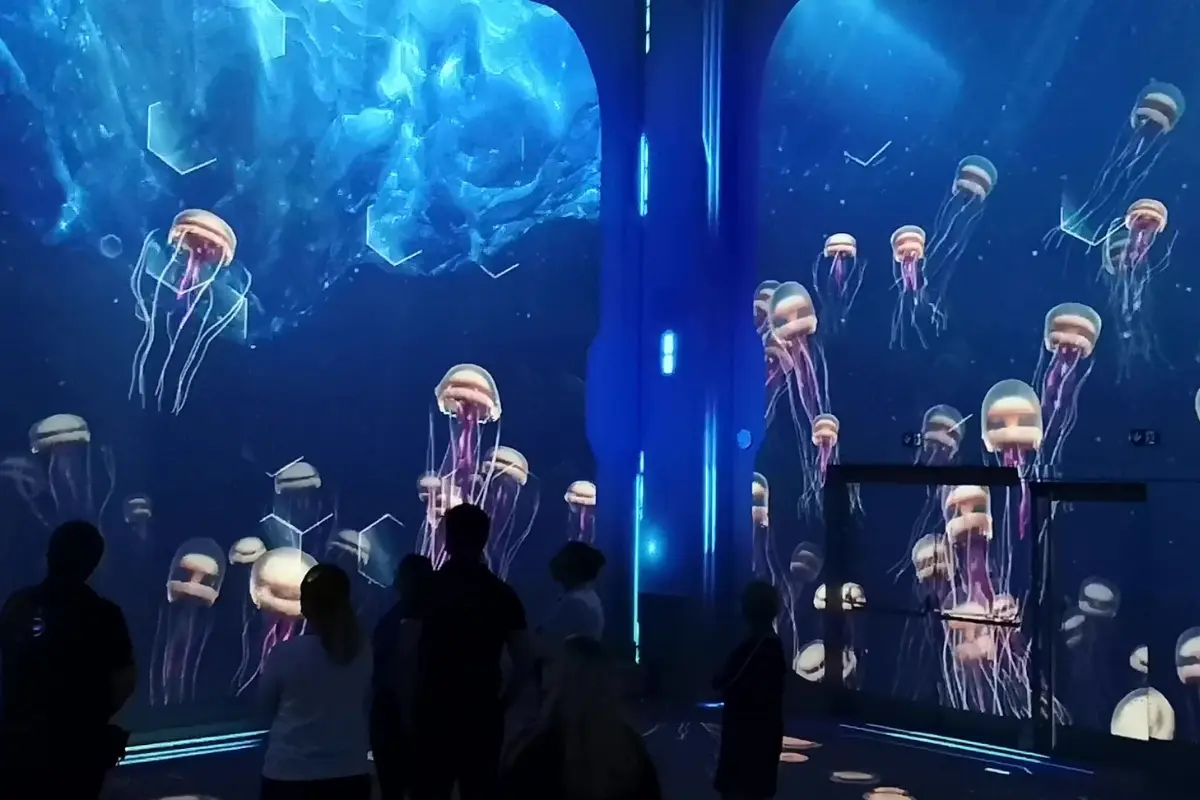
An immersive audiovisual installation transforms a physical space through an architectural design that combines imagery, sound, lighting, and interactivity. Video projections, LED screens, spatial audio, and control systems are integrated into the venue to serve the installation’s artistic vision.
Videlio brings your creative vision to life as an immersive installation tailored to the space’s dimensions, surfaces, presentation conditions, and audience needs. Our teams design the audiovisual architecture, select the technologies, and coordinate their operation for both temporary and permanent installations.
A stage design conceived as a comprehensive audiovisual system
Creating an immersive scenography requires considering visuals, sound, lighting, and control systems as components of a single system. Their design must adapt to the venue, the audience’s path, and operational constraints in order to translate the scenographic vision into the space.

Designing the Image on a Spatial Scale
Dimensions, surface geometry, brightness, and viewing angles determine the display architecture. The design process also takes into account resolution, available viewing distance, and visual continuity in order to adapt the projection or LED display to the space.

Create a spatialized sound environment
Spatial audio places audio sources in space in a way that aligns with the visual staging. The placement of the speakers, the venue’s acoustics, and synchronization with the image all contribute to the precision of the immersive experience.

Synchronize image, sound, and light
Media servers and show control systems coordinate the delivery of content with audio, lighting, and automation. A centralized architecture makes it easier to trigger scenarios and control the audiovisual system.

Incorporating interactivity into the user journey
Sensors, tracking systems, and interfaces enable the device to respond to the audience’s actions or presence. Content can thus be triggered or adapted according to the defined scenario, while remaining integrated into the overall audiovisual system.
Why choose Videlio for your immersive audiovisual design?
A scenographic vision often requires integrating multiple technologies within a space with specific constraints. Videlio provides the audiovisual engineering needed to transform this vision into a coherent technical architecture.
Our teams work alongside set designers, architects, and creative teams to define solutions tailored to the venue. They analyze the projection surfaces, audio systems, lighting, audiovisual networks, and control systems required for the project.
This cross-disciplinary expertise allows us to orchestrate projection, LED displays, sound, lighting, media servers, and interactivity within a single system. Videlio also provides operation and maintenance services when the immersive installation is intended for long-term use.
Projects such as Jam Capsule and Nausicaa demonstrate this ability to combine multiple areas of audiovisual expertise to create an immersive experience.
What technologies are used for immersive audiovisual set design?
Equip Your Workspaces
Hybrid meetings, presentations, training, content creation: Your spaces must provide a seamless experience for both on-site and
Contact Us
Planning an audiovisual project? Tell us about your needs. Our teams will connect you with the right expert for your
Cultural venue
Transform your cultural spaces into immersive experiences that captivate visitors, showcase the artwork, and enrich educational programming. Videlio designs,Legal Notice
Pursuant to Article 27 of the Data Protection Act of January 6, 1978, the information provided is essential
Do you have an immersive set design project you'd like to bring to life?
Our teams review your concept, the venue’s characteristics, and the proposed technologies to design a suitable audiovisual system and verify its technical feasibility.


















How does Videlio support your immersive scenography project?

Analyze the site and its constraints
Our teams study the architecture, floor space, lighting, acoustics, infrastructure, and operating conditions. This analysis establishes the technical framework for the immersive experience.

Defining the Audiovisual Architecture
The studies determine the layout and sizing of the systems. Choices regarding projection, display, audio, broadcasting, and control are tailored to the scenographic concept and the identified constraints.

Test and validate the system
These tests allow us to verify the rendering, calibration, and synchronization of the systems before final deployment. They validate the technical choices made for the project.

Integrate, commission, and operate the facility
The teams install the equipment, configure the settings, and make adjustments prior to commissioning. To ensure long-term reliability, Videlio can then provide system monitoring, support, and maintenance to assist with their operation and future upgrades.
Tailored services and support

Audit
and ConsultingOur teams assess your audiovisual equipment, facilities, and usage patterns to anticipate obsolescence, prioritize your investments, and develop a roadmap.

User Support and Staffing
Support, troubleshooting, and on-site technicians: Our teams ensure the safety of your meetings, make it easier to use the equipment, and take the pressure off your in-house staff on a daily basis.

Maintenance and Managed Services
Maintenance, monitoring, and managed services: Our teams anticipate incidents and ensure the continuity of service for your audiovisual equipment.
What You Need to Know About Immersive Audiovisual Design
An immersive audiovisual installation combines visuals, sound, lighting, interactivity, and control systems within a unified framework. It adapts these technologies to the venue and the defined visitor journey.
Video projections, video mapping, LED walls, immersive sound, virtual or augmented reality, and interactive installations can all be used to create an immersive space. The choice depends on the venue, the content, the intended uses, and technical constraints.
Video mapping precisely adapts an image to the geometry of a surface or a three-dimensional space. Immersive projection uses one or more projection surfaces to extend the visual environment around the audience.
Ambient light levels, image dimensions, available space, viewing distance, and installation constraints all influence the choice. A site survey allows for a comparison of suitable configurations.
Media servers and show control systems can manage content and coordinate the various pieces of equipment. This architecture makes it possible to trigger and synchronize audiovisual sequences.
Yes. Immersive installations can be permanent fixtures in museums, cultural venues, or brand spaces. Their design must therefore take into account operational requirements, maintenance, and future developments.