
Holograms: How does it work ?
Focus on Holographic Technology
Brought back into the spotlight by the 2017 and 2022 presidential campaigns, holographic technology has been given a fresh new look and has become a MUST-HAVE for events. Videlio invites you to explore this technology, which remains a mystery to many of us.
Holograms: how does it work ?
One might think this technique is innovative, given how breathtaking and surprising it seems, but although it’s hard to believe, this technology dates back two centuries. In fact, it was invented in 1862 by an English engineer named Henry Dircks and was later adapted for the theater by John Pepper. Known at the time as “Pepper’s Ghost,” this nearly 150-year-old process remains one of the most widely used methods for creating what we now call a “hologram.”
In reality, the technical complexity of holography, while technical, is not an insurmountable challenge. The process is as follows: a laser beam is split into two rays by a reflective mirror. Next, one of these rays is directed onto a special plate, while the second is aimed at the object or person to be reproduced before being reflected back onto that same plate. The photosensitive plate reproduces the object’s volume through the interference that occurs between the two waves. Like its cousin, photography, this process does more than just capture shapes and colors; it also captures volume to create that 3D effect.
As a result, the Videlio teams had the opportunity to join Jean-Luc Mélenchon’s “Les Insoumis” campaign tour to bring his holographic project to life. Videlio set up live holograms for the event.

What are the keys to a successful live hologram?
The hologram must be life-size (scale 1), which imposes certain constraints:
- Fixed camera at approximately 7 m
- The character moves within a relatively confined space (4 m x 2 m)
- A black background is required throughout the camera’s field of view
- Lighting should be primarily side-lit and backlit to create depth
- The floor surface should be slightly glossy to create depth
- Clothing should be relatively light in color (black and white are prohibited)

WHAT ARE THE KEYS TO SUCCESS FOR A LIVE HOLOGRAM?
The hologram must be life-size (scale 1), which imposes certain constraints:
- Fixed camera at approximately 7 meters
- Character movement within a relatively confined space (4 meters x 2 meters)
- A black background is required throughout the camera’s field of view
- Lighting should be primarily side-lit and backlit to create depth
- The floor surface should be slightly glossy to create depth
- Clothing should be relatively light in color (black and white are prohibited)
OTHER TYPES OF HOLOGRAMS
Holograms, as we know them today in this stage format with live broadcasts, can take on other forms with equally impressive results:

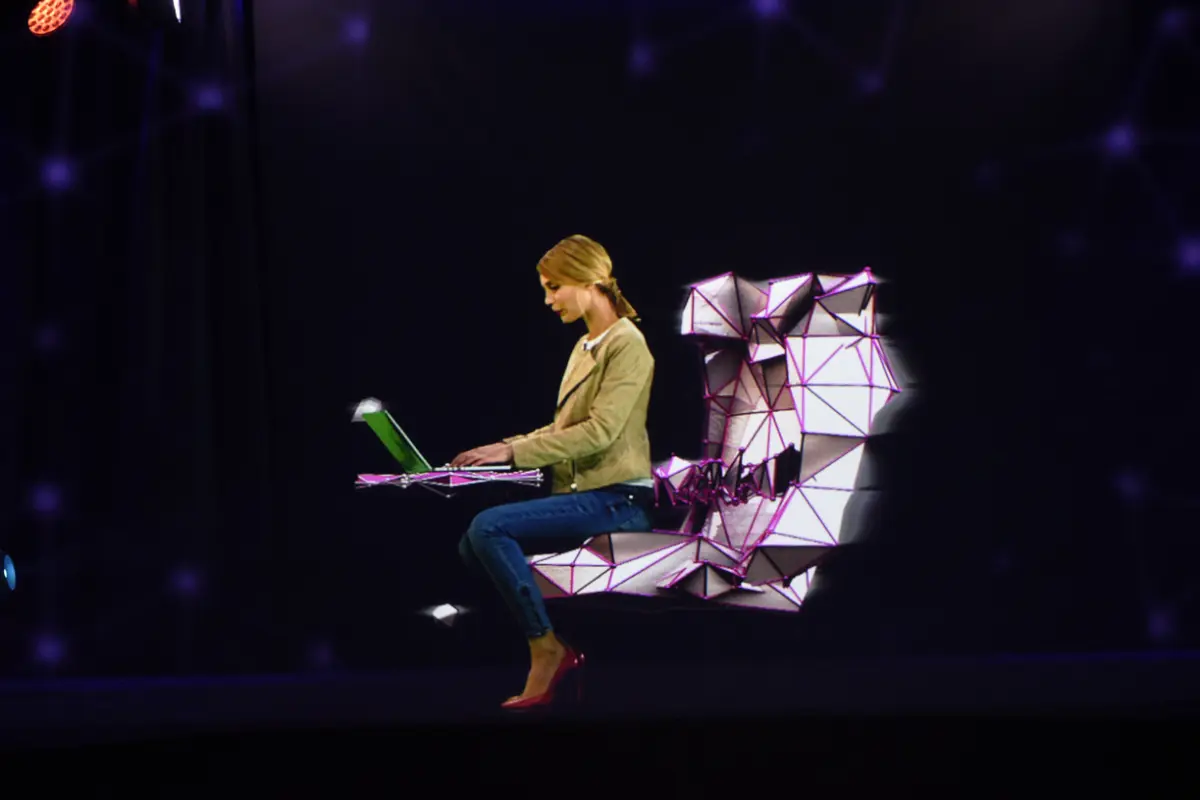
- Based on the same technical principle, but on a smaller scale, in a black box for a product presentation—as SNCF Travel did when it unveiled its new first-class seats in 2016.

- In a pyramid—whether inverted or not—to highlight small-scale elements
-
It appears to float thanks to the Holoproj device, which projects a video stream using a beam of light-emitting diodes (LEDs) positioned along each of these “propellers.” As they spin like a windmill, the beams create a circle within which the pre-downloaded video is displayed. The black background thus becomes transparent as it rotates, creating the effect of a 3D hologram. As a result, viewers of this visual experience feel as though they are seeing 3D animations floating in the air. Since early 2018, Videlio – Events has had Holoproj units in its fleet.
Technologies that blend the past and the future, limited only by your imagination.